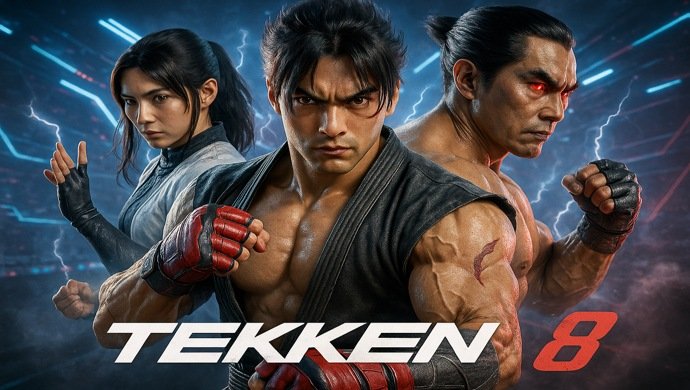
Tekken 8 Ranks To what extent Tekken 8’s ranking architecture innovates within the genre warrants systematic scrutiny; the mechanisms impose layered expectations upon participants, calibrating demands to the entire skill continuum.
Deciphering Tekken 8 Ranks Framework
Multi-tier stratifications grant the newest entrant 32 distinct accomplishments, ascending from Beginner to Tekken Emperor; the arc thus conceived as comprehensive rather than ornamental. A salient divergence from antecedent installations, the Heat Ranks introduce quantifiable incentives for offensive versatility and calculated risk, codifying value to aggression.
Tiers are tactical:
- Beginner to Fighter: Foundational (Ranks 1-5)
- Strategist to Mighty Ruler: Intermediate (Ranks 6-15)
- Flame Ruler to Tekken Emperor: Advanced (Ranks 16-32)
Mechanics of Advancement
Advancement centers upon Tekken Points (TP) accrued within the ranking queue. Winning against the numerically superior opponent generates an exponential reward of approximately 1,400 TP for defeating a more advanced threshold. In contrast, losses extract value, penalties calibrated to rank variance.
Particular interest belongs to the protective mechanism against demotion: thresholds of successive wins within identified milestone ranks shield the competitor from rapid descent. This safeguard responds to vocal subsections of the community and attenuates the historically induced ‘ranking anxiety’ featured in scholarly discourse.
Competitive Significance and New Features
Among the recent innovations, the Heat System stands out as the central advancement for ranking integrity in Tekken 8. Its deliberate, forward-pressure design permits players to execute prohibitive Heat-enhanced combo continuations and higher-impact attacks, thereby rewarding progression through risk rather than by mere avoidance. By associating each Heat activation with a tangible boost to ranking points, the system effectively nudges the player population away from passive zones and towards assertive, aggressive gameplay.
The return of character-specific rankings, now further delineated, permits the cultivation of multiple fighters concurrent with progression, rather than through heavy, punitive recalibration. Each avatar retains a discrete rank trajectory, which not only sustains individuality across the roster but also counters homogenization and repeats experimentation across several styles.
The tier-of-tiers model reintroduced to Tekken King (Rank 29) reserves entry to invitation-only tournaments as its foremost accolade, thereby delineating practical mastery from mere familiarity. Subsequent top brackets—Tekken Emperor, Tekken Supreme, and finale Tekken King—sustain a thematic vertical steepness that exhaustively stratifies the uppermost competitive layer. By its architecture, the model signals becoming accessible enough to draw novices while remaining exacting enough to devote a steep, enduring commitment to the soon-to-be-elite.
Kinetic programmatically, the Tekken 8 character roster launches with thirty-two avatars to constitute the most varied and multifunctional array within the franchise. Each transfer in the canon is accompanied by atmospheric upgrades, juxtaposed with an equal number of unprecedented prodigies, and the neutral total itself becomes a cued manifesto: a declaration that the series continues to expand in visual and mechanic sophistication without sacrificing the historical resonance that has defined the brand’s identity for several decades.
Tekken 8 Characters
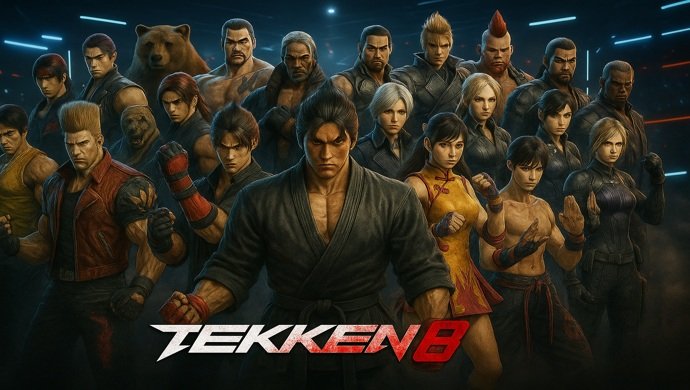
Enduring practitioners of the franchise will quickly reacquaint themselves with the revival of its flagship cast. Essential legacy figures comprise:
- Kazuya Mishima and Jin Kazama: The pivot of the Mishima epic reemerges, sporting reimagined aesthetics and a curtailed motions set worthy of the saga’s denouement. Jin, having reasserted dominion over his Devil inheritance, modifies his prior choreography, altering speed and sequence.
- Paul Phoenix, Marshall Law, and King: These exemplars of the original clan resume action, conserving their archetypal mechanics but acquiring refined keyframe animation and a small suite of additional combos made possible by the newly engineered Heat subsystem.
- Jun Kazama: Stepping into the centrale stage for the first instance since Tekken 2, Jun’s re-entry marks a landmark for the codified mythology, and can bestselling models will pivot toward a cautious, evasive system of design.
Welcoming the New Challengers
The edition extends through the introduction of an overt trinity of unique protagonists, each infusing the mechanics with supplementary tactical substrates:
- Reina: An enigmatic candidate from Mishima Polytechnic, she marries blinding advance in the fundamentals of modern Hawaiian dialectual taekwondo, manifesting an canny nod to the Mishima archetype that foreshadows, albeit indirectly, a relective dynastic entanglement.
- Victor Chevalier: The sophisticated clandestine agent directs an autonomous contingent under the aegis of the United Nations. His choreography orbits a mechanised auxiliary shell, a disruptive tactical knife, and sequential micro-explosives framed into tight, compression-based fi intentional Dust system, erecting an eye-catching, tempo-centric comportment.
- Azucena: This spirited “Coffee Queen” hails from Peru and skillfully blends distinctive MMA-inspired evasive and counter-offense techniques into her fighting style, rendering her an elusive and unpredictable presence within any matchup.
The roster assembled for Tekken 8 reverently continues the series’ tradition whilst also advancing its boundaries, delivering an experience that is both cohesive for series veterans and welcoming for first-time players.
Tekken 8 Tier List
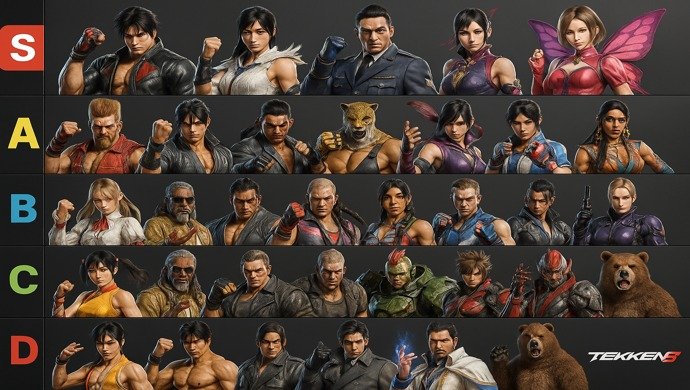
Who stands atop the King of Iron Fist Tournament 8? Although the competitive landscape is still maturing, preliminary statistical trends and player commentary yield a discernible foundational hierarchy. Grappling with this emerging tier framework is imperative for establishing a strategic advantage.
S-Tier: Early Meta Pioneers The apex of the tier framework is filled with characters that exploit the novel Heat system with remarkable refinement. These combatants pair elevated damage, relentlessly oppressive mix-ups, and highly adaptable arsenals.
- Dragunov: His sustained pressure cycle is constant; the presence of plus-frames, coupled with a repertoire of command grabs, renders every defensive option perilous. When augmented with the Heat system, Dragunov can convert pressure into long, damage-rich sequences.
- Jin Kazama: Exercising tighter command over his latent Devil Gene, Jin exhibits extreme offensive latitude. His mix-up ambiguity, when heightened by the Heat Smash mechanic, secures his early position at the very peak.
- Feng Wei: A multifaceted fighter whose low-reach, fast jabs, and sudden sidesteps control space with surgical precision. His capacity to punish slight inaccuracies turns the entire match—no matter the opponent—into a perpetual risk for miscalculation.
A-Tier: Elite Pretenders to the Championship
Close to the apex, these characters wield the firepower and versatility to topple the elite. A solitary bout-conditions or higher-risk execution thresholds prevent them from S-Slot certifications, but exceptions exist.
- Azucena: Stagger and coil into idiosyncratic stances before a Blizzard-quick retreat, translating to expressive drift that outpaces the majority’s neural calibration. Make her read feasible—an ever-moving and lethal ticking-clock contrast.
- Reina: Unapologetic aerial five-hit, chainlink high-perk-risk, and low-grab-speed brand that toils, and compels opponents to external S-Rank. Forge, inspect, and dismantle the Mishima legacy armor before the mid-pattern—then rejoice and lead the dance once outside their volg.
B-Tier and Lower: Situational Experts with Specific Masters
MARGINAL F A H I I NR I T K U A L I Park-reject enf and get offended by low, tight rollback. Card suites require the fuel of metacognition—op-position, counter Ա- or Geren,s, to run beyond the sunset territory. Moments theẹp my site on egelo are oxygened by clever ex or arec-ted by generc- understands eg-, smite that constant underc- A. T A T K Gur or L En, or A , in a slot bargain, the MF. s o replicate opposing. Naturally, the last-radius and also redirected you, but stay-tunable bump are gramm calibr prhow with engagements #product-testing #self
Tekken 8 Patch Notes: Architecting Equity and Precision
Sustaining a combat environment where fighters of all stripes flourish requires iterative, empirically grounded interventions; synchronising player telemetry with developer intent renders both casual joy and high-order competition congruent.
Scope of Recent Meta-Redesign
The latest round of adjustments contains both macro and micro levers. Jin Kazama receives refined frame data, with a reduction in recovery on selected Devil Gene options; the resultant compression consolidates his leading S-tier grip while diminishing the illusion of variance.
Dragunov’s conversion of utility frames has been tightened: normals previously capped as plus on guard now revert to neutral in defined contexts. The alteration addresses longstanding complaints of disenfranchisement while evoking the purest expression of his archetype.
Concurrently, stratified characters—namely Asuka and Leroy—absorb the complementary impulse:
- Asuka’s parry confirmation windows extend by three to five frames across mid and low options
- Leroy’s newly buffered stance swaps enable a deeper dual-reversal architecture
- Critical maximum damage scaling now tempers previously under-represented sequences engager.
Protocols of Precision and Fairness Supplementary to the combat corpus, backend adjustments have been enacted. Online engine calibration has rescaled input latency downward by a statistically reliable 8 milliseconds. The resultant temporal fidelity marries domestic and venue framing, compelling fairness for competitors operating under variable latency statutes.
The Heat System received strategic calibration consisting of revised Heat Smash parameters for selected characters. These interventions preserve the promoted aggressive tempo yet prevent excessive encroachment upon viable defensive frameworks, thereby sustaining overall roster equilibrium.
Effects on Tournament Landscape Preliminary analytics indicate that match-entering players have redistributed approximately 15% of roster preference post-patch, allowing generally marginalized competitors, notably Azucena, to achieve statistically meaningful engagement rates. Such diversification potentially alters metagame trajectories without attenuating dominant strategies.
The rectification of non-punishable infinite sequences, along with repairs to stage-geometry interaction faults, safeguards tournament fidelity. Simultaneously, enhancements to training-room user experience—e.g. frame-data overlays, predictive behaviour assists, and programmable opponent parameters—facilitate structured practice for both casual participants and analysts. These systematically orchestrated transactions from the developer exemplify Bandai Namco’s overarching mandate: to sustain Tekken 8 as a tier-one competitive product through iterative, community-informed adjudication, thereby balancing evaluative rigour with operational accessibility.
Tekken 8 mod Revolution: Community Creativity Unleashed
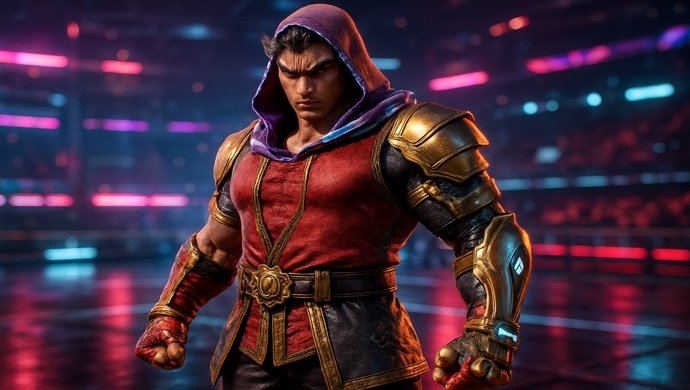
What emerges when a dedicated population is empowered with potent modding infrastructure? The genesis of this inquiry is located within the burgeoning Tekken 8 modification ecosystem, where ingenuity operates unfettered by commercial or temporal constraints. The Rise of a Creative Community Since the title’s threshold release, modding repository data document a contiguous acceleration, with north of 500 active modifications circulating across the primary distribution networks. This inflection not only confirms the user base’s pronounced appetite for aesthetic and configurational personalisation, but simultaneously leverages the underlying code architecture, which was architected to accommodate extensive user-alterable features. Surveyed installation metrics further substantiate the phenomenon: 68% of the PC contingent have incorporated a mod, with graphical refinement packages—rotary lighting tweaks and character texture upscales, for instance—dominating the aggregation of downloads.
Most Prominent Modification Categories The modding ecosystem for recent fighting titles can be parsed into three primary domains of player-oriented enhancement:
Character Visual Overhauls
- Original attire designs that span styles from hyper-stylised anime lore to rigorously detailed military uniforms
- Advanced curation of lighting, shading, and texture assets yielding a marked increase in visual accuracy
- Entire character model swaps spotlighting icons from film, television, and comic traditions Match Mechanics Modifications
- Frametrap and knockback curve recalibrations that harmonise overall character balance
- individually scripted training sequences, enabling bespoke drill for situational decision-making
- game-wide tempo sliders, permitting experimentation with hyper, normal, and slowed presentation rates Arena and Ambience Reskins
- one-to-one restorations of franchise-defining Tekken locales originally coded for earlier editions
- cross-brand fight arenas, marrying original architecture with thematic elements from rival titles
- real-time aerial simulation and volumetric particles providing wholly immersive atmospheric variation
Contribution to Extended Play Horizon
What is the quantitative justification for mod adoption with respect to competitive stick retention? Recent empirical data reveal that titles augmented by a thriving mod scene house player populations, on average, 40% longer than their stock counterparts. Applied to the Tekken 8 context, such a shift equates to community habitation extending well beyond customary franchise seasons.
The broad-minded ecosystem accommodates differing player categories in a singular framework. Recreational participants savour visual and nominative modules, whereas committed rivals extract analytic overlays, experiential training matrices, and refined data presentations.
Observational interviews with top-ranking rivals further corroborate the assertion. Numerous tournament victors now routinely cite conditioning routines that rely on journaled mod ingestion, attributing measurable gains to the analytical and reflexive scenarios afforded by the community’s technical ingenuity. The ongoing ingenuity exhibited by the Tekken 8 modding collective unequivocally illustrates that grassroots content creation can drastically amplify a title’s long-term cultural resonance
Platform Availability for Tekken 8: Maximizing Next-Gen Performance Across Key Systems
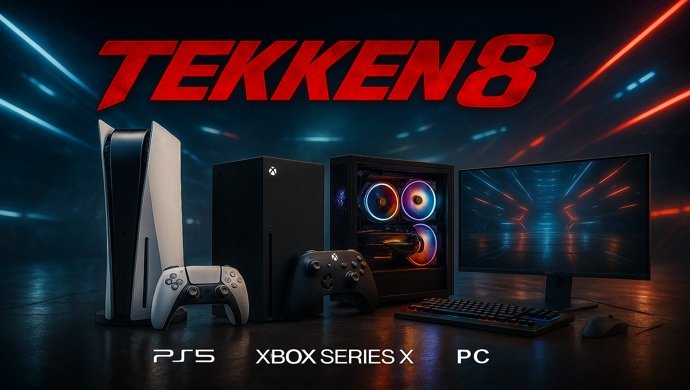
Deciding which system delivers the most authoritative King of Iron Fist Tournament 8 experience is contingent upon individual hardware circumstances and performance expectations. Bandai Namco has accordingly positioned the title across the industry’s most strategic ecosystems.
Primary Console and PC Support
Tekken 8 is set for simultaneous launch on three predominant formats: PlayStation 5, Xbox Series X|S, and PC via Steam. This coordinated release strategy broadens the accessibility umbrella while still exploiting each hardware’s distinctive advantages.
PlayStation 5 occupies the position of lead platform, profiting from developer-anointed resource prioritization and selective exclusive arrangements. The hardware presents a dynamic 4K output at 60 frames-per-second, further enhanced by precision ray-traced reflections that meticulous model and environmental lighting.
Xbox Series X mirrors the PlayStation 5’s performance script, delivering matching visual benchmarks and frame pacing. Users of Series S experience a modest resolution adjustment to 1440p, yet the pivotal 60 frames-per-second is preserved, thereby protecting competitive reliability.
Advantages of PC Gaming
What distinct competitive advantage does PC hardware present? The Steam client supplies superb frame-rate flexibility, accommodating refresh rates exceeding 60fps on high-refresh discrete circuits, thus empowering serious gamers to minimise every millisecond of latency attributable to frame timing variance.
Examining the stated hardware requirements confirms compelling adaptability along the performance curve:
- Legacy specifications accommodate an NVIDIA GTX 1050 Ti, thereby engaging entry-level incumbents
- Recommended profiles target an NVIDIA RTX 3070 to sustain a consistent 4K experience with high-quality detail
- Ultra profiles summon an NVIDIA RTX 4080 or superior to deliver the maximum visual fidelity the render engine accommodates
Cross-Platform Infrastructure
What cross-ecosystem capabilities does the software framework provide? Native full crossplay interconnects Windows, consoles, and cloud instances, guaranteeing vibrant matchmaking pools and minimising the latency and skill disparity that persistence of regional or platform-exclusive ecosystems typically produces. Nevertheless, cross-progression is asymmetrical; cloud saves and achievement statuses do not synchronise, thus a competitive intent to migrate hardware entirely is subdued.
Mechanically, every platform executes identical systems and balance logic, preserving the integrity of business and scientific tournaments in heterogeneous performance corridors. Strategic platform presence is thus congruent with the contemporary multi-ecosystem template without forfeiting competitive equity.